
The Munich Manual of Demonic Magic
Latin Manuscript, 15th C
BSM Clem.849
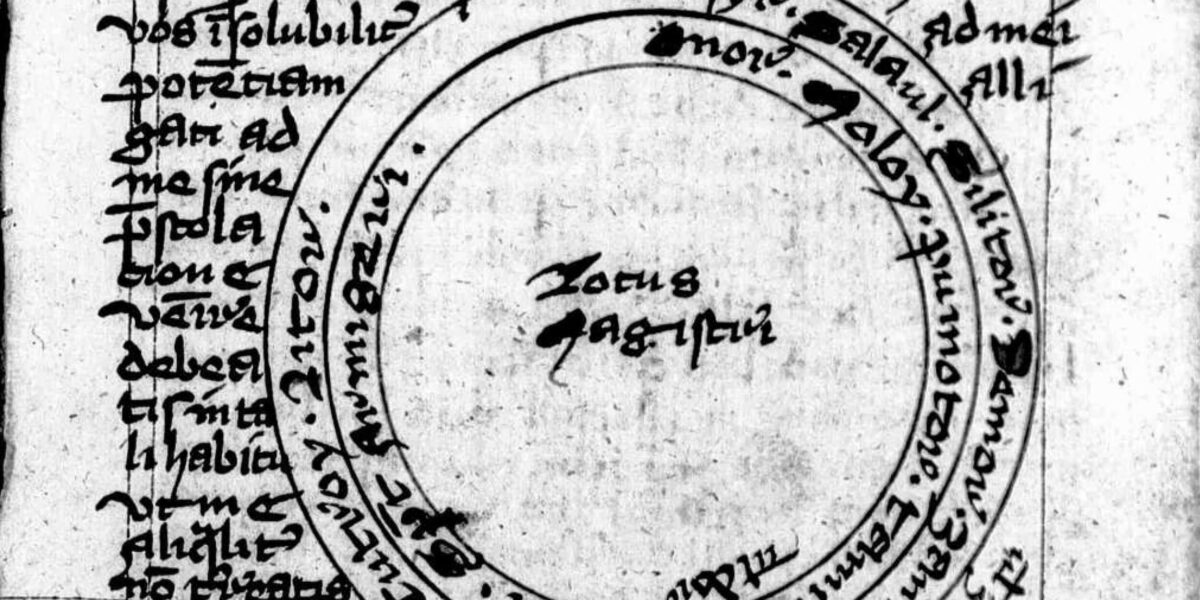
Liber incantationum, exorcismorum et fascinationum variarum (CLM 849 of the Bavarian State Library, Munich) is a fifteenth-century grimoire composed in Latin. It is concerned with demonology and necromancy with the largest number of experiments, nineteen in all, divinatory. Although many of the experiments can be used for obtaining knowledge of any kind, others have more specific aims such as locating stolen goods or capturing a thief. The characteristic features of these operations include the use of scrying and the employment of a child—most often a prepubescent boy born of a legitimate marriage—who alone is believed capable of seeing and communicating with the spirits that are conjured. The text documents a comprehensive range of evocationary scrying techniques, including the use of mirrors, vessels, bones, crystals, fingernails, and thumbnails as reflective media.
The scrying operations described in the Munich Handbook are remarkably similar to those practiced in the Islamicate world, known as darb al’mandal (drawing the circle) or istinzal arwah (drawing down the sprits). These practices, as in the Munich Handbook, were considered applicable to a wide range of situations but were predominantly employed for the detection of thieves.
In 1998, Richard Kieckhefer edited this manuscript with a full scholarly commentary, offering detailed analysis of its text and contents, published under the title Forbidden Rites: A Necromancer’s Manual of the Fifteenth Century.